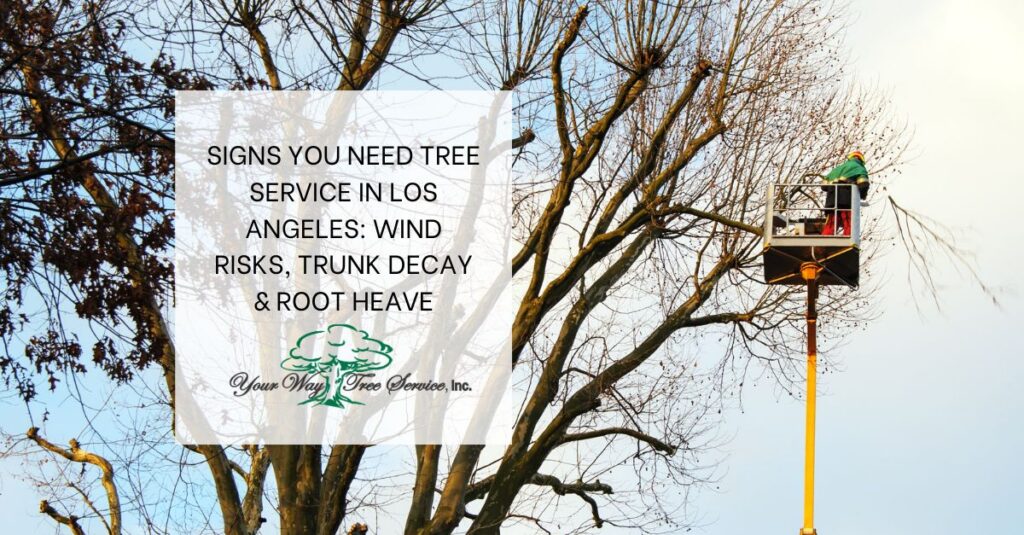
What are the primary signs that a tree in Los Angeles requires immediate professional service?
The primary signs you need tree service in Los Angeles include:
- Soil and Root Instability: Visible ground heave, horizontal soil fissures, or an uncharacteristic lean following winter atmospheric river storms.
- Trunk and Structural Compromise: Fungal conks (e.g., Ganoderma), deep vertical bark fissures, hollow cavities, or included bark at tight V-shaped co-dominant stem unions.
- Canopy and Branch Hazards: Sudden limb drop during high-heat summer periods, heavy deadwood accumulation, and dynamic wind-load vulnerability during dry Santa Ana wind events.
- Biotic Infestations: Boring entry holes accompanied by wet frass and sap weeping caused by the Invasive Shot Hole Borer (ISHB) or Western pine beetles.
Maintaining mature trees across the Los Angeles basin provides vital urban canopy cover, lowers cooling costs in heat-island environments, and elevates real estate valuations. However, the intersection of altered Mediterranean microclimates, compacted urban soils, and extreme seasonal weather patterns subjects Southern California trees to distinct structural vulnerabilities.
Confined parkways, restricted root zones along paved infrastructure, and prolonged drought cycles followed by sudden precipitation stress both broadleaf hardwoods and evergreen conifers.
When internal biomechanical flaws or physiological decline remain unchecked, trees transition from valuable urban assets into high-liability hazards. Recognizing the critical signs you need tree service in Los Angeles allows residential homeowners, commercial facility directors, and municipal property managers to address structural decay, mitigate root-plate destabilization, and prepare canopies for regional wind dynamics.
Canopy Stress, Sudden Limb Drop, and Overextension
The upper crown serves as an accurate diagnostic indicator of a tree’s internal vascular and biomechanical health. In metropolitan Los Angeles, canopy stress is often exacerbated by severe soil compaction, impermeable paving, and variable irrigation regimes spanning the inland valleys to the coastal plain.
Visual Indicators of Canopy Dieback
Crown dieback typically initiates at the outer perimeter of the canopy. When root systems suffer vascular dysfunction, drought shock, or soil-borne infection, the tree restricts resource allocation to primary structural stems, abandoning peripheral branches.
- Foliage Chlorosis and Thinning: Premature yellowing, browning, or thinning of leaves out of phase with normal deciduous dormancy.
- Deadwood Accumulation: Retention of dead, brittle branches greater than two inches in diameter suspended within the intermediate and upper crown.
- Clustered Epicormic Sprouting: Dense flushes of weak, vertical water sprouts emerging directly along main scaffold limbs, indicating severe environmental shock or severe interior defoliation.
Summer Branch Drop in Regional Species
Summer Branch Drop (SBD) is a hazardous arboricultural event common throughout the San Fernando Valley, San Gabriel Valley, and central Los Angeles. On hot, calm summer afternoons—typically when ambient temperatures exceed 90°F without accompanying wind—apparently sound, mature limbs snap cleanly and drop without warning.
This phenomenon frequently impacts high-canopy, heavy-wood species, including:
- Blue Gum and Red Gum Eucalyptus (Eucalyptus globulus, E. camaldulensis)
- Aleppo and Canary Island Pines (Pinus halepensis, Pinus canariensis)
- Valley and Coast Live Oaks (Quercus lobata, Quercus agrifolia)
Arborists attribute SBD to internal moisture regulation changes, extreme transpiration stress, and sapwood cell collapse under heavy horizontal limb weight.
Mitigating this risk requires selective end-weight reduction, canopy balance pruning, and the elimination of overextended horizontal scaffolds.
Utility Line Intrusion and Clearance Standards
Canopy encroachment into high-voltage electrical distribution corridors presents extreme fire and electrocution risks. In Southern California, tree-to-wire contact can ignite fast-moving wildland-urban interface fires during seasonal weather anomalies.
Under California Public Utilities Commission (CPUC) General Order 95 (Rule 35), minimum clearances must be maintained between tree branches and power infrastructure at all times:
- Non-High Fire-Threat Districts (Non-HFTD): Minimum 18-inch radial clearance around electrical supply conductors.
- High Fire-Threat Districts (HFTD – Tier 2 and Tier 3): Minimum 4-foot radial clearance year-round, with a recommended 12-foot clearance envelope at time of trimming to accommodate dynamic branch sway under storm conditions.
Biomechanical Trunk Defects, Internal Decay, and Co-Dominant Stems
A tree’s primary bole must withstand static gravitational mass and dynamic lateral wind loading. Structural defects along the trunk compromise mechanical strength, often without showing symptoms in the upper crown foliage.
Co-Dominant Stems and Included Bark Wedging
Co-dominant stems form when two or more main trunks of similar diameter emerge from a single junction. The structural viability of this union depends on the physical branch angle:
- U-Shaped Junctions: Exhibit interlocking wood grain fibers at the branch bark ridge, forming a stable attachment.
- V-Shaped Junctions with Included Bark: Display an acute angle where expanding trunk bark folds inwardly into the union. Rather than forming continuous, load-bearing wood-to-wood bonds, the trapped bark acts as an internal wedge. As the stems gain mass, wind forces push the trunks apart, making the junction prone to splitting during moderate wind events.
Remediation requires either structural crown thinning, the installation of supplemental dynamic cabling systems complying with ANSI A300 (Part 3) standards, or selective tree removal of the subordinate stem.
Heartwood Rot, Cavities, and Fruiting Conks
Internal heartwood rot degrades the inner cellulose and lignin architecture of the trunk while the outer vascular sapwood remains functional, creating a hazardous hollow shell.
External signs of advanced internal fungal decomposition include:
- Basal Fungal Fruiting Bodies: The appearance of wood-decay shelf fungi, such as Ganoderma applanatum (Artist’s Conk) or Inonotus species, protruding from the lower trunk or root flare indicates extensive internal delignification.
- Trunk Cracks and Inward Cavities: Vertical fissures penetrating through the bark and sapwood, often caused by past pruning injuries, vehicular impact, or thermal cracking.
- Borer Frass and Wetwood Weeping: Liquid oozing from trunk wounds (bacterial wetwood/slime flux) accompanied by internal cavitation.
When the ratio of sound exterior wood to the total trunk radius falls below 30% to 33% (evaluated via sonic tomography or resistograph micro-drilling), the probability of catastrophic stem failure under lateral wind loading rises dramatically.
Root Plate Mechanics, Soil Failure, and Wet Microclimates
The root plate anchors massive above-ground weights through a complex network of lateral framework roots and subterranean taproots. Because Los Angeles microclimates swing from severe summer drought to intense precipitation, the physical mechanics of the soil-root interface are vulnerable to rapid structural destabilization.
Ground Heave, Soil Fissures, and Lean Metrics
Ground heave is one of the most critical structural emergencies an arborist encounters. It occurs when a tree’s lateral root plate shears, fractures, or detaches from the subterranean soil matrix:
- Tension Fissures: Crescent-shaped cracks forming on the side opposite an unnatural trunk lean.
- Mounding Soil: Soil or turf heaving upward at the base of the root flare, indicating root pull-out under tension.
- Recent Lean: Any tree displaying a newly developed lean exceeding 10 to 15 degrees from vertical requires urgent structural assessment.
Atmospheric River Impact on Hillside Soils
The greater Los Angeles region features complex mountain and foothill geography, from the Santa Monica and San Gabriel Mountains to the steep hillside parcels of Hollywood Hills, Silver Lake, and Encino. During intense atmospheric river storms, several inches of precipitation can fall across the basin within 24 to 48 hours.
Prolonged saturation degrades the friction coefficients of Southern California clay and decomposed granite soils. Structural risks compound on hillsides:
- Soil Shear Failure: Fully saturated slopes lose cohesive strength, allowing gravity to pull the entire root plate downslope.
- Hydraulic Uplift: Saturated subterranean layers convert lateral root anchoring points into floating levers, causing sudden blow-downs without hurricane-force winds.
- Erosion Undermining: Stormwater surface runoff strips protective overburden away from buttress roots, destabilizing foundational slope anchors.
Hardscape Conflicts and Parkway Root Alterations
In suburban and urban corridors, trees often compete with municipal infrastructure. Expansive surface roots lift concrete sidewalks, buckle asphalt driveways, and crack retaining walls.
Severing large roots during construction or sidewalk repair severely destabilizes the tree. Cutting a single lateral root measuring over 3 inches in diameter within the Critical Root Zone (CRZ)—defined as a radius of 1 to 1.5 feet per inch of trunk diameter at breast height (DBH)—can eliminate up to 25% to 40% of the tree’s structural anchoring capacity.
Santa Ana Wind Hazards, Drag Coefficients, and Canopy Physics
Santa Ana winds are katabatic, high-velocity wind events that originate over the Great Basin and funnel through mountain gaps into the Los Angeles basin, bringing sudden gusts between 40 and 70+ mph and relative humidity levels below 10%. These dry winds generate intense mechanical forces on broadleaf trees and heavy conifers alike.
Aerodynamic Drag and Canopy Porosity
A dense, unpruned tree functions as an aerodynamic sail. As wind speeds double, the wind load exerted on a tree’s canopy increases by a factor of four. The mechanical force applied to the upper crown transfers down the trunk as rotational torque, focusing stress directly on the basal root flare.
Improper practices like “topping” or shearing stimulate dense outer clusters of weakly attached epicormic shoots, which increase wind drag while reducing interior airflow.
Precision crown thinning, executed to ANSI A300 pruning standards, selectively removes cross-branches and dense inner foliage. This balances canopy porosity to allow wind to pass freely through the crown, lowering the drag coefficient and mitigating lever-arm forces on the root plate.
When a tree presents multiple high-risk factors in close proximity to structures, utility corridors, or high-occupancy zones, proactive tree removal eliminates the danger of unassisted structural collapse.
Regional Biotic Threats and Vascular Pathogens
Abiotic stresses like drought and heat lower systemic immune defenses across urban tree populations, making them vulnerable to lethal insect borers and vascular fungi.
Invasive Shot Hole Borers (ISHB)
The Polyphagous and Kuroshio Shot Hole Borers (Euwallacea fornicatus and E. kuroshio) represent severe biotic threats to urban canopies in Los Angeles County. These microscopic ambrosia beetles bore entry galleries into the xylem of susceptible hosts, introducing a symbiotic fungal pathogen, Fusarium euwallaceae.
- Susceptible Hosts: California sycamore (Platanus racemosa), Box elder (Acer negundo), Fremont cottonwood (Populus fremontii), and various willow and oak species.
- Symptoms: Entry holes approximately 0.85 mm wide (comparable to a ballpoint pen tip), distinct wet staining, sugar exudates (“sugar volcanoes”), and localized branch dieback.
- Mechanical Failure: The fungal network blocks water and nutrient transportation, causing rapid brittle branch syndrome, internal rot, and limb failure.
Goldspotted Oak Borer (GSOB)
The Goldspotted Oak Borer (Agrilus auroguttatus) threatens native oak populations in foothill communities. GSOB larvae feed on the cambium and phloem layers of mature Coast Live Oaks and California Black Oaks (Quercus kelloggii).
Infestations manifest as:
- D-shaped emergence holes roughly 3 mm wide in outer bark.
- Dark, red-to-black sap weeping from the lower and mid-trunk.
- Rapid canopy foliage thinning, with leaves turning greyish-brown while remaining attached to dead branches.
Bark Beetle Complex in Conifers
Prolonged drought suppresses sap pressure in conifer species throughout the foothills and urban basins. Healthy pines exude thick oleoresin to expel boring beetles. Stressed trees cannot generate this hydraulic defense, allowing beetles like the Western Pine Beetle (Dendroctonus brevicomis) and Ips species to colonize the phloem:
- Diagnostic Signs: Pitch tubes (small white, cream, or red globes of resin) in bark crevices; fine, cinnamon-colored boring dust (frass) collected on lower bark plates and ground surfaces.
- Crown Decline: Needles turn rapidly from pale green to dull yellow, then rusty red within 4 to 8 weeks. Once a pine canopy turns completely brown, internal vascular flow has ceased, requiring prompt removal to stop pests from spreading to adjacent stands.
Technical Tree Service Solutions: Preservation vs. Extraction
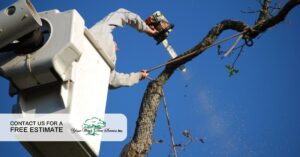
Addressing structural faults, pathogen infestations, and environmental wind hazards requires specialized arboricultural engineering. Certified arborists determine whether a tree can be safely preserved through structural mitigation or must be dismantled using heavy extraction equipment, such as crane-assisted tree removal.
| Intervention Type | Applicable Structural/Biological Conditions | Mechanical Action & Procedure | ANSI Standard Benchmark |
|---|---|---|---|
| Crown Thinning & Weight Reduction | Heavy end-weight scaffolds; dense crowns with high wind drag; Summer Branch Drop risk[cite: 26] | Precision removal of selected lateral foliage (not to exceed 20–25% of live crown); end-weight reduction on long horizontals[cite: 26] | ANSI A300 (Part 1: Pruning)[cite: 26] |
| Dynamic Cabling & Bracing | Co-dominant stems with included bark; split structural crotches that retain sound wood[cite: 26] | Installation of high-strength synthetic or steel cable systems at two-thirds the height of the union to redistribute dynamic loads[cite: 26] | ANSI A300 (Part 3: Supplemental Support Systems)[cite: 26] |
| Root Flare Excavation & Decompaction | Buried root collars; soil compaction; girdling roots choking vascular flow[cite: 26] | Supersonic air-tool (Air-Spade) decompaction; targeted surgical excision of non-structural girdling root tissue[cite: 26] | ANSI A300 (Part 8: Root Management)[cite: 26] |
| Crane-Assisted Tree Removal | Dead/hazardous specimens; root plate failure; structural instability in tight or zero-clearance access areas[cite: 26] | Rigging trunk and canopy sections to mobile hydraulic cranes; vertical extraction over obstacles without surface ground impacts[cite: 26] | ANSI Z133 (Safety Requirements for Arboricultural Operations)[cite: 26] |
Signs You Need Tree Service in Los Angeles: FAQs
What are the earliest signs that a tree’s root system is failing?
The earliest indicators of root system failure include horizontal soil cracking, ground heaving where turf or soil pulls upward opposite an unnatural lean, and the formation of a distinct gap between the trunk base and surrounding soil.
Additional symptoms include mushrooms or bracket conks growing directly on the root flare, dead lateral buttress roots visible at grade, and sudden canopy dieback without clear above-ground causes.
How do I know if a tree in Los Angeles is protected by local ordinances?
Under the City of Los Angeles Protected Tree and Shrub Ordinance (Ordinance No. 186873), native trees measuring 4 inches or greater in cumulative diameter at 4.5 feet above ground level (DBH) are protected from removal or heavy pruning without a formal permit.
Protected native species include the Coast Live Oak (Quercus agrifolia), Western Sycamore (Platanus racemosa), Southern California Black Walnut (Juglans californica), and California Bay Laurel (Umbellularia californica). Certified arborist reports and site surveys are required prior to initiating work on protected species.
Can a hollow tree trunk be saved, or does it have to be removed?
A hollow tree trunk does not automatically require complete removal. If the tree maintains a sufficient cylinder of sound wood around its perimeter—typically at least 30% to 33% of the total trunk radius—and has developed strong callus wood around old margins, it can often be stabilized.
Management strategies include crown reduction pruning to lower wind load forces and the installation of structural support systems. However, if the hollow is paired with fungal conks, vertical trunk cracks, or severe lean, removal is often necessary.
Why do tree limbs suddenly snap and fall during hot summer weather?
Sudden limb drop occurs during sustained periods of high heat and calm weather, typically impacting mature eucalyptus, oaks, and pines. Extreme temperatures drive intense transpiration rates, triggering internal changes in wood moisture, sapwood vascular pressure, and cell structure.
Heavy horizontal limbs fail under their own cantilever mass without wind. Targeted weight reduction pruning and selective canopy balancing by certified arborists effectively reduce these structural failures.
What should I do immediately if a tree leans toward my house after a heavy storm?
If a tree develops a sudden lean toward your house after severe rain, clear the area beneath and within the potential fall zone immediately. Inspect the base of the trunk for signs of active ground heave, fresh soil cracks, or exposed, snapped roots.
Do not anchor ropes or winches to vehicles, which can trigger immediate root-plate release. Contact an ISA Certified Arborist
with emergency response capabilities to inspect the root plate, deploy stabilization rigging, and safely remove or cable the tree using specialized equipment.
Proactive arboricultural maintenance protects structural property value, prevents sudden hazards, and maintains the safety and beauty of the Southern California urban landscape. Engaging an ISA Certified Arborist ensures every structural defect, root conflict, and microclimate risk is diagnosed accurately and remediated to professional safety standards.