
How often do I need palm tree trimming in Calabasas?
In Calabasas’s Very High Fire Hazard Severity Zones (VHFHSZ), fast-growing palms like Mexican Fan Palms require annual dead-frond trimming to eliminate vertical fuel ladders before peak Santa Ana wind events, while slower-growing Canary Island Date Palms require pruning every 18 to 24 months alongside annual fruit and seed pod removal. In short, depending on your situation, you’ll need palm tree trimming in Calabasas every year or two.
Across Calabasas hillside communities—from The Oaks, Mountain View Estates, and Hidden Hills borders to Mulholland Highway and Old Topanga Canyon corridors—mature palm trees present severe wildfire hazards when neglected. Dense skirts of desiccated, dead fronds hanging beneath the crown act as vertical fuel ladders that ignite instantly when exposed to wind-driven embers.
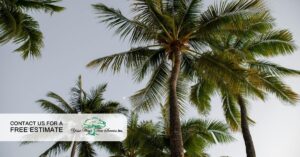
Because palms are monocots that lack true woody bark, burning fronds shed flaming debris across adjacent clay-tile roofs, steep chaparral slopes, and protected native Quercus agrifolia (Coast Live Oak) canopies.
Scheduling professional palm tree trimming in Calabasas with an ISA certified arborist removes dry, hanging fronds, heavy seed pods, and fibrous fruit stalks to satisfy Los Angeles County Fire Department (LACoFD) and Calabasas Municipal Code defensible space mandates.
Routine dead-frond stripping also reduces canopy wind sail during high-velocity canyon gusts, preventing whole-crown failure while protecting residential structures and surrounding native vegetation from rapid fire spread.
Eliminating Ember Traps: Calabasas VHFHSZ Skirt Removal and Fire Compliance
Wildfire readiness in the Santa Monica Mountains foothills requires proactive canopy management across every microclimate—from sun-baked inland valleys near the 101 Freeway to marine-influenced canyon bottlenecks along Las Virgenes Road.
At Your Way Tree Service, we help homeowners, commercial property managers, and homeowner associations maintain strict compliance with local fire codes while preserving the architectural symmetry of mature specimen palms.
When dead foliage accumulates year after year, it creates a dry, fibrous column that traps windblown sparks and harbors roof rats directly beside homes and outbuildings.
| Fire & Structural Risk Factor | Unpruned / Overgrown Palm Skirt | ANSI A300 Compliant Palm Crown |
|---|---|---|
| Ember Ignition & Fuel Ladder Risk | High; dry thatch ignites rapidly and sheds flaming debris onto roofs and brush | Minimal; dead fronds and dry petiole litter are completely cleared |
| Santa Ana Wind Sail Load | Severe; dense dead skirts catch canyon gusts, stressing root plates and trunks | Reduced; open aerodynamic profile allows gusts to pass through green fronds |
| LACoFD Defensible Space Status | Non-compliant within 100-foot VHFHSZ fuel modification zones | Fully compliant with Los Angeles County Fire Department inspection standards |
| Pest & Rodent Harborage | High; thick frond skirts shelter roof rats, pigeons, and stinging insects | Low; open crown eliminates sheltered nesting cavities near eaves |
| Hardscape & Pool Impact | Heavy seed stalks and falling fronds stain concrete and clog pool skimmers | Clean; emerging flower spikes and fruit clusters are severed before drop |
Defensible Space and Brush Clearing Coordination
Managing tall palms goes hand in hand with maintaining ground-level clearance across steep canyons and residential lots. In Calabasas, hot, dry summers bake coastal sage scrub, chamise, and non-native annual grasses into flash fuels by late spring. When our crew arrives on your property, we evaluate how your palms interact with surrounding shrubs, groundcover, and protected native oaks.
Combining dead-frond stripping with comprehensive brush clearing services eliminates continuous vertical and horizontal fuel pathways from the canyon floor up into the high canopy. By clearing dry thatch, fallen seed clusters, and excess organic litter within the 100-foot defensible space perimeter, we help property owners pass annual LACoFD brush clearance inspections and avoid costly municipal abatement notices.
Reducing Wind Sail During Santa Ana Events
High-velocity Santa Ana winds funneling through Malibu Canyon and surrounding mountain passes place immense mechanical stress on unpruned palm crowns. Heavy skirts of dead fronds catch 50-to-70-mph gusts like a solid sail, whipping the upper trunk back and forth until shallow root plates loosen in saturated winter soils or weakened trunks snap.
Through targeted palm tree trimming in Calabasas, we strip away excess dead weight and aerodynamic drag before peak autumn and winter wind seasons arrive. When severe weather does strike and causes sudden limb or crown failure, rapid emergency tree response clears fallen debris, secures damaged trees, and restores safe access to driveways and roofs.
Protecting the Apical Meristem: Why Proper Pruning Avoids Hurricane Cuts
Unlike broadleaf shade trees that compartmentalize wounds through secondary wood growth, palms are monocots possessing a single terminal growing point—the apical meristem (or heart)—located at the very apex of the trunk.
Over-pruning healthy green fronds above the horizontal plane, a destructive practice commonly called “hurricane cutting” or “pineapple pruning,” starves the palm of photosynthetic capacity, weakens the upper trunk diameter, and exposes the tender meristem to intense San Fernando Valley summer sunscald and winter canyon frost.
Our ISA certified arborist specialists follow strict ANSI A300 pruning standards, removing only dead, dying, or broken fronds hanging below the nine-to-three o’clock horizontal line along with messy flower and seed clusters.
Preserving healthy green fronds maintains structural crown balance, prevents potassium and manganese deficiencies common in Canary Island Date Palms (Phoenix canariensis) and Mexican Fan Palms (Washingtonia robusta), and ensures year-round architectural vigor.
Identifying Stress from Over-Pruning
Many property owners mistakenly request aggressive green-frond removal in an effort to extend the time between maintenance visits. Unfortunately, stripping away healthy green foliage forces the palm to draw stored carbohydrate reserves directly from its upper trunk, resulting in a permanent narrow constriction known as pencil-pointing.
Once the upper trunk narrows, a palm lacks vascular cambium and can never thicken that section again, leaving the heavy crown permanently vulnerable to snapping during canyon windstorms years later. Relying on scheduled palm tree trimming in Calabasas keeps your trees on a balanced cycle that removes true fire and fall hazards without sacrificing photosynthetic health.
Managing Fruit Stalks, Seed Pods, and Trunk Skinning
Beyond dead fronds, seasonal spring and summer flowering cycles produce heavy, messy fruit stalks that stain travertine patios, clog pool filtration systems, and attract roof rats and yellowjackets. During a scheduled visit, our technicians cleanly sever emerging flower spikes and mature seed clusters before they ripen and drop onto hardscapes.
For clients seeking a clean, uniform trunk profile on Mexican Fan Palms or native California Fan Palms (Washingtonia filifera), we also perform careful trunk skinning—removing loose, peeling petiole bases (boots) while leaving the underlying protective cylinder completely intact.
Equipment and Rigging Protocols for Steep Estates
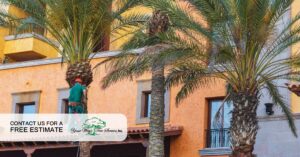
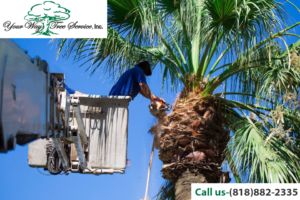
Calabasas properties frequently feature narrow hillside driveways, terraced gardens, and delicate hardscapes directly beneath towering palms. Our crew deploys compact spider lifts, aerial bucket trucks, friction brakes, and controlled lowering ropes to bring heavy frond bundles and 40-pound seed stalks down safely without impacting pool decks, custom masonry, or ornamental plantings. Whether servicing a single courtyard specimen or dozens of street trees along an HOA perimeter, precision rigging protects your landscape from impact damage.
Safe Extraction and Green Waste Recycling for Declining Palms
When a mature palm succumbs to Fusarium wilt, South American Palm Weevil damage, or severe structural leaning, prompt extraction prevents sudden trunk collapse onto neighboring structures or power lines. Our team handles complete palm removal across tight residential lots and commercial campuses using precision sectional rigging and low-impact ground protection. For towering specimens located behind homes, over swimming pools, or along inaccessible canyon slopes, we utilize crane-assisted tree removal to lift heavy trunk sections cleanly over obstacles without disturbing surrounding landscaping.
Complete Stump Grinding and Site Cleanup
Removing the trunk is only half of the process when preparing a yard for native replanting or hardscape renovation. Palms possess dense, fibrous basal root balls rich in silica that dull standard blades and resist natural decay for decades.
Following trunk extraction, high-torque stump grinding equipment chews through the tough basal root mass well below grade so you can reclaim the space for fire-wise native plantings or patio extensions. Every frond, trunk section, and wood chip leaves your property through a dedicated green waste recycling program, diverting organic debris from local landfills.
Scheduling Your Calabasas Palm Inspection
Keeping your palms healthy, structurally sound, and compliant with Los Angeles County fire regulations starts with an on-site evaluation by trained professionals. Whether you need seasonal palm tree trimming in Calabasas, fire-code skirt removal, or hazardous tree extraction, Your Way Tree Service delivers licensed, insured, and ISA certified arborist care tailored to your landscape.
Contact our team today to arrange your complimentary property consultation and written estimate.
Frequently Asked Questions About Palm Tree Trimming in Calabasas
What is the best time of year to trim palm trees in Calabasas?
Late spring through early summer (May to July) is the ideal window to trim palm trees in Calabasas. Pruning during this period removes dead winter fronds and emerging spring flower stalks simultaneously, ensuring trees are fully compliant with Los Angeles County Fire Department inspections before peak autumn Santa Ana wind and wildfire season arrives.
While dead, hazardous fronds can be safely removed year-round, scheduling your primary maintenance in late spring maximizes cleanliness and fire safety. Severing flower spikes before they develop into heavy seed clusters prevents summer staining on driveways and eliminates food sources for roof rats during the warmest months of the year.
Why is hurricane cutting harmful to palm trees?
Hurricane cutting—removing healthy green fronds above the horizontal nine-to-three o’clock line—deprives the palm of vital nutrients, weakens the upper trunk, and can permanently damage the single terminal growing point (apical meristem).
Because palms cannot regrow lost trunk girth, severe over-pruning causes a permanent structural narrowing called pencil-pointing. Following ANSI A300 standards by retaining all healthy green fronds preserves photosynthetic energy, protects the tender heart from intense inland sunscald, and maintains wind resistance during canyon gusts.
Do Calabasas fire codes require dead palm fronds to be removed?
Yes. Under Los Angeles County Fire Department (LACoFD) and City of Calabasas Very High Fire Hazard Severity Zone (VHFHSZ) regulations, property owners must remove dead palm fronds and accumulated dry organic litter within defensible space zones to eliminate vertical fire ladders and windborne ember traps.
Neglected palm skirts ignite rapidly during brush fires and launch burning embers hundreds of yards onto neighboring roofs and hillsides. Annual dead-frond stripping keeps residential estates and commercial HOAs compliant with municipal fire inspections.
Why should tree trimmers never use climbing spikes on live palm trees?
Metal climbing spikes puncture the outer trunk wall and permanently scar a palm’s vascular bundles, creating open wounds that never heal and serve as direct entry points for lethal fungal diseases like Fusarium wilt and Pink Rot.
Professional arborists exclusively use spikeless aerial bucket trucks, compact lifts, or specialized climbing harnesses to access tall palm crowns safely while keeping the protective exterior trunk intact.